Sound familiar?Welland
- The call
- The padlock on the shed has been stiff all summer. Today the key twisted, cracked at the tip, and left the end buried deep in the keyway. The rest came out in your hand, and the padlock is still closed.
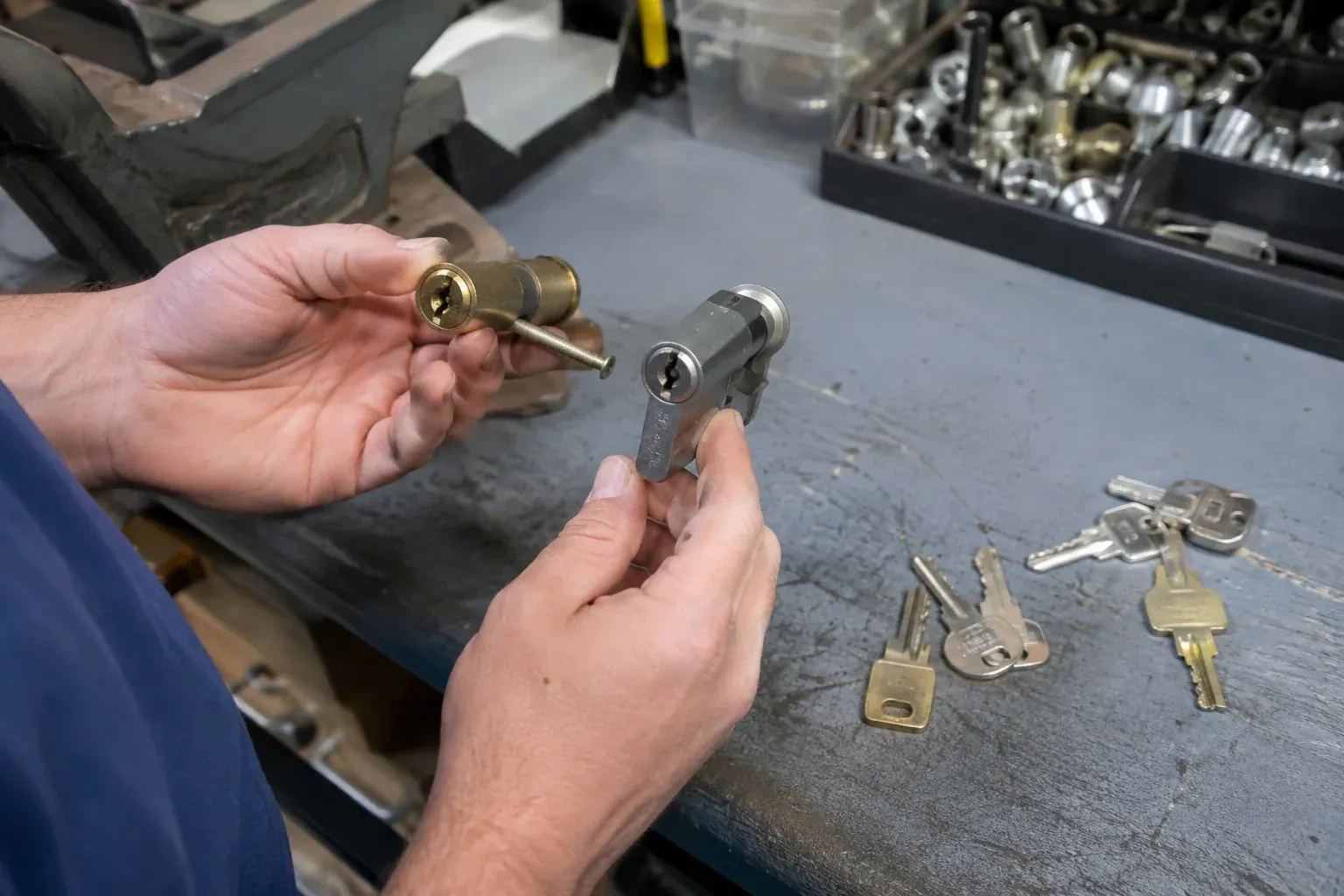
That key had been bending a little for years, and you kept straightening it. Today it finally cracked at the deepest cut.
Two facts shape the job before the locksmith arrives: whether the door is locked or unlocked, and whether any of the key is showing. A fragment that protrudes can often be gripped and drawn straight out. One flush or deep needs extractors worked in alongside it. If the plug turned before the key broke, it has to be eased back to its resting position first so the pins line up and release the blade. A locked door means the extraction is followed by opening the lock; an unlocked one means securing it is the priority. Either way the door ends up locking with a key that fits.
Sound familiar?Welland
Broken Key Extraction · Welland
Scene 1
The first look is at the fragment itself, without touching it. Does any of the blade show above the cylinder face, or is it flush or deeper still? Is the plug sitting at its normal rest position, or did it stop partway round when the key gave way? A protruding piece in a resting plug is the simplest case. A fragment past the shear line in a rotated plug means the pins are holding it, and the plug has to be brought back before anything will slide. Reading this correctly decides which extractor comes out of the case and spares the keyway from needless probing.
Scene 2
When a fragment sits flat in the keyway with its cuts facing the pins and nothing for a hook to catch, a spiral extractor is the tool. It looks like a very fine screw on a handle. Slid alongside the blade and turned gently, its threads bite into the ridges of the key cuts and grip them. The locksmith then pulls straight back, and the fragment comes with it. A second spiral from the other side of the blade is sometimes used to steady the piece. It is slow and careful work, and it leaves the pins and springs exactly where they were.
Scene 3
You leave with a key that was cut to the lock's original specification rather than traced from the tired blade that just failed. That difference shows every time you use it: it seats fully, lifts each pin cleanly and turns without a wiggle. Two or three copies made from that fresh cut give you spares that are as good as the first. The old bent or thinning keys that shared the ring are worth retiring now, because a key that has started to bend has started to crack, and the next one to snap will be one of them.
What shapes the quoteMaple Park Locksmith Co.
FeesSame any hour
Photo identification and something that connects you to the lock. For a house or apartment that is a lease, a bill, addressed post, or confirmation from the property manager; for a business, your role there; for a vehicle, the registration or ownership papers with matching identification. If the documents are inside, say so on the phone and the check is completed once the door is open.
It helps if there is one. A crisp spare is the ideal pattern for the replacement, better than the broken halves and far better than a worn copy. It also lets the locksmith test the cylinder the moment the fragment is out, which shows whether the pins and springs are sound. If the spare is itself bent or worn, mention that too; it is a candidate for retirement rather than a pattern.
It is rare, and it is discussed before anything changes. A glued, jammed or corroded-in fragment can usually still be reached by taking the cylinder off the door and working the plug out from the back. If even that fails, the cylinder is drilled where plug meets housing, sacrificed and replaced on the spot with new keys cut, so the door locks normally by the time the locksmith leaves.
NiagaraOntario
Broken Key Extraction · Pelham, Crowland, Maple Park, Stop 19, Welland South, Fonthill, Kunda Park, Fenwick, Ridgeville
Every square is one home in a hundred.
On-site assessment
That key had been bending a little for years, and you kept straightening it.
(365) 364-0824, open 24/7.
On-site assessment preferred · (365) 364-0824, open 24/7